Insurance is an agreement between you (or your business) and an insurance company to protect your finances in the event of a loss in exchange for regular payments called premiums. For medical, dental or vision insurance, it might also help keep you or your family healthy by paying for — and in some cases covering — the cost of routine care.
The policy itself is the insurance contract. The policy defines who or what is covered under the agreement, the conditions under which the insurer will pay out and how much they will pay.
Insurance
Insurance is a form of risk management in which an individual or entity can receive financial protection or reimbursement against losses from an insurance company.
It functions as a risk sharing means by under which many individuals pay premiums to an insurance system to protect themselves from the potential burden of having losses. Insurance is a popular risk management tool that can be used to protect you from any unexpected finances due to accidents, illness, disaster and other events leading to property damage or of death.
History of Insurance
The concept of insurance is Is There An Previous For Insurance? Some of the earliest known forms of risk-sharing were practised by Chinese and Babylonian traders in 3000–2000 bc.
The Code of Hammurabi, from ancient Babylon, had provisions that acted to distribute risk. The Greek and Roman “benevolent societies” also gave members money for funerals.
Contemporary insurance developed in Europe during the Middle Ages. The earliest written insurance policy in known history appears to have been made in 1347 in Italy. Subsequently after the Great Fire of London in 1666, better organised systems for fire insurance came to be.
Principles of Insurance
Insurance works on a series of fundamental principles designed to ensure fairness and reduce abuse:
Utmost good faith: Both the parties should give full details of every material value.
Insurable Interest: An insurer agrees to accept the possibility of a catastrophic loss in consideration of the payment of a premium, so there must be sufficient interest from the policyholder’s perspective as well.
Indemnity: The insurance company indemnifies, or compensates, the insured in the case of certain losses only up to the insured’s interest.
Right of Subrogation Once it makes a loss payment, the insurer may acquire your right to sue for damages from the responsible third party.
Contribution : If there is more than one policy covering the loss, each insurer will contribute rate-ably.
Proximate Cause : Claims are settled based on the primary cause of loss.
Minimizing Losses : Policyholders should take appropriate steps to minimize losses.
Why is insurance important?
Insurance helps to financially protect you, your dependents and your assets from emergencies , unexpected expenses , and losses. It manages risk by passing on the financial consequences to providers, in return for a series of regular (typically monthly) payments known as premiums. An insurance policy can also help with expenses involving everyday health care, property damaged by a natural disaster or veterinary costs if your pet gets sick.
In the end, insurance should help keep you secure and happy, whatever life throws at you. insurance to help protect yourself, your family and you.
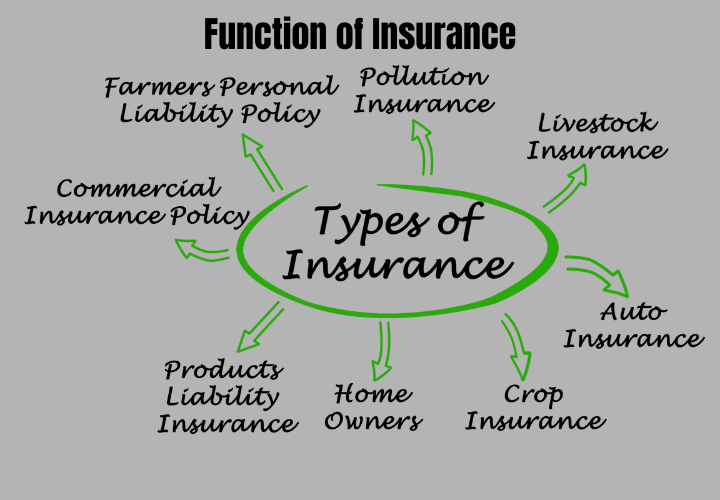
Types of Insurance
Insurance can be broadly classified into several major types:
health insurance
Covers medical expenses such as hospitalization, preventive care and surgeries.
life insurance
Pays a lump sum to dependants when the policyholder dies.
Property and Casualty Insurance
This would be home owner’s/r renter’s insurance and property protection against fire, theft or other natural disasters.
Automobile Insurance
Vehicles, and the damage done to them in accidents as well as liability for injury and property damage are included.
Legal Insurance
Provides access to legal aid, documentation and lawyer representation.
How does insurance work?
The mechanism for insurance is based on risk sharing, where various policy holders make contributions to a pool. Because losses do not affect all policyholders simultaneously, the premiums paid in cover costs for those who incur them.
The process generally includes:
Writing the policy: The insurer underwrites, or evaluates, the risk and brings in the premium.
Payment of Premium: The policyholder pays premiums at regular intervals.
Loss Event: A covered event of loss occurs.
Making a claim: The policyholder hands over evidence and asks for payment.
Appraisal: The insurance company checks the claim to make sure it’s covered.
Payment: Claims paid directly to policy holder or service providers for admitted claims.
Final Thoughts
From being a basic means to share risk and liability, insurance has developed in a significant financial protection tool for individuals, companies but also national economies. It is critical to shield populations from unforeseen financial hardship, stabilize households, foster entrepreneurship, and support governments in times of crises or natural disasters. Sharing risk more broadly can be a source of financial safety and stability in the long run.
Having a basic resource material that discusses the mechanics of insurance – its concepts, classification, importance and benefits – helps you make wise and informed decisions concerning your personal or commercial needs. Amid rapidly evolving global demands like climate change, digital threats and increasing healthcare expenses our industry responds with innovative solutions that bridge the gap by offering not just modern answers to those needs, but technology-based capabilities and customer-focused coverages.
Insurance in a sentence (word usage in recent Hindu newspaper) Insurance continues to be an essential bedrock for society—preparing us for the unknown and underpinning our courage to move forward.